
Over the past month, AI‑related disruption concerns have triggered a sharp selloff across global markets, business services and technology software stocks have been pummelled. In Australia, the ASX listed information technology sector has experienced one of the steepest valuation resets since the early 2000s. The S&P/ASX 200 Tech Index is now down 16% Year to date and 40% since September 2025, with many stocks falling at rates faster than those experienced during the pandemic crash of March 2020 or Global Financial Crisis of 2008, refer to table below.
Source: Reuters, global software stocks hit by anthropic wake up call, https://www.reuters.com/business/media-telecom/global-software-stocks-hit-by-anthropic-wake-up-call-ai-disruption-2026-02-04/, accessed 10/02/2026
Anthropic AI Cowork
AI commoditisation, particularly following Anthropic’s latest AI tool Cowork has accelerated the downturn. Cowork is built on “agentic” architecture allowing users to have a digital assistant which can read, edit, create, and organise files directly on a workspace. Early demos of the agent show an ability to solve non-technical, everyday work without significant user inputs. The reason why this has been so disruptive is that existing tools rely on coding to make the AI agent more productive rather than working independently. The tool allows users to assign tasks, step away, and return to completed outputs such as reports, slide decks, spreadsheets, or organised folders within their workspace. Other advancements include tidying up email inboxes and conducting analytical research. Investors globally are reassessing whether traditional software business models can withstand rapid advances in AI automation, prompting widespread derating of listed company valuations even among long‑term market leaders.
Investors globally are concerned businesses which rely heavily on SaaS economics to derive revenue are at risk as the value proposition for a consumer of their product shifts from software vendors to an AI model provider. Established workflow platforms are being challenged in the face of AI models which can source information accurately and efficiently without the need for a SaaS solution to narrow the search field for a human agent. Investors are questioning whether these tools have the potential to make it easier to switch software providers or remove the need for them all together. In Australia stocks such as Car Group, owner of Carsales.com.au fell 12% in the first few days of February. Rea Group, the owner of realestate.com.au is down 17% from its 52 week trading high.
Insurify (ChatGPT)
Market fears over AI advancements have also rattled more traditional business models. On 10th February, insurance companies globally sold off heavily over fears of an AI driven model disrupting the segment. Australian insurance broker Steadfast fell 9.46% in a single day and now trades 36% below its 52 week market high. Insurify, a US based app powered by ChatGPT, allows car owners to input a vehicle’s condition, the client’s credit history, driving record and other inputs to compare and source the best value insurance products on the market[1]. The concern is these AI driven models are going to make it easier for consumers to switch insurers and go direct to market, rather than via an insurance broker who acts as a intermediary. Consumers may be more willing to pay a service fee to purchase coverage via an app powered by ChatGPT rather than a human insurance broker.
The advancements in AI are compelling and disruptive to traditional business models. Nevertheless, investors are still cautious about the capital expenditure required for leading technology providers to remain competitive. Alphabet’s (the parent owner of Google) announcement of US$175–185 billion in 2026 capex for AI datacentres and infrastructure rattled markets on the day of the announcement, highlighting the scale of investment required to remain competitive. A report by CBA states that US hyperscaler capital expenditure is on track to exceed US$500 billion annually from 2026.[2].
Proven wealth winners looking cheap
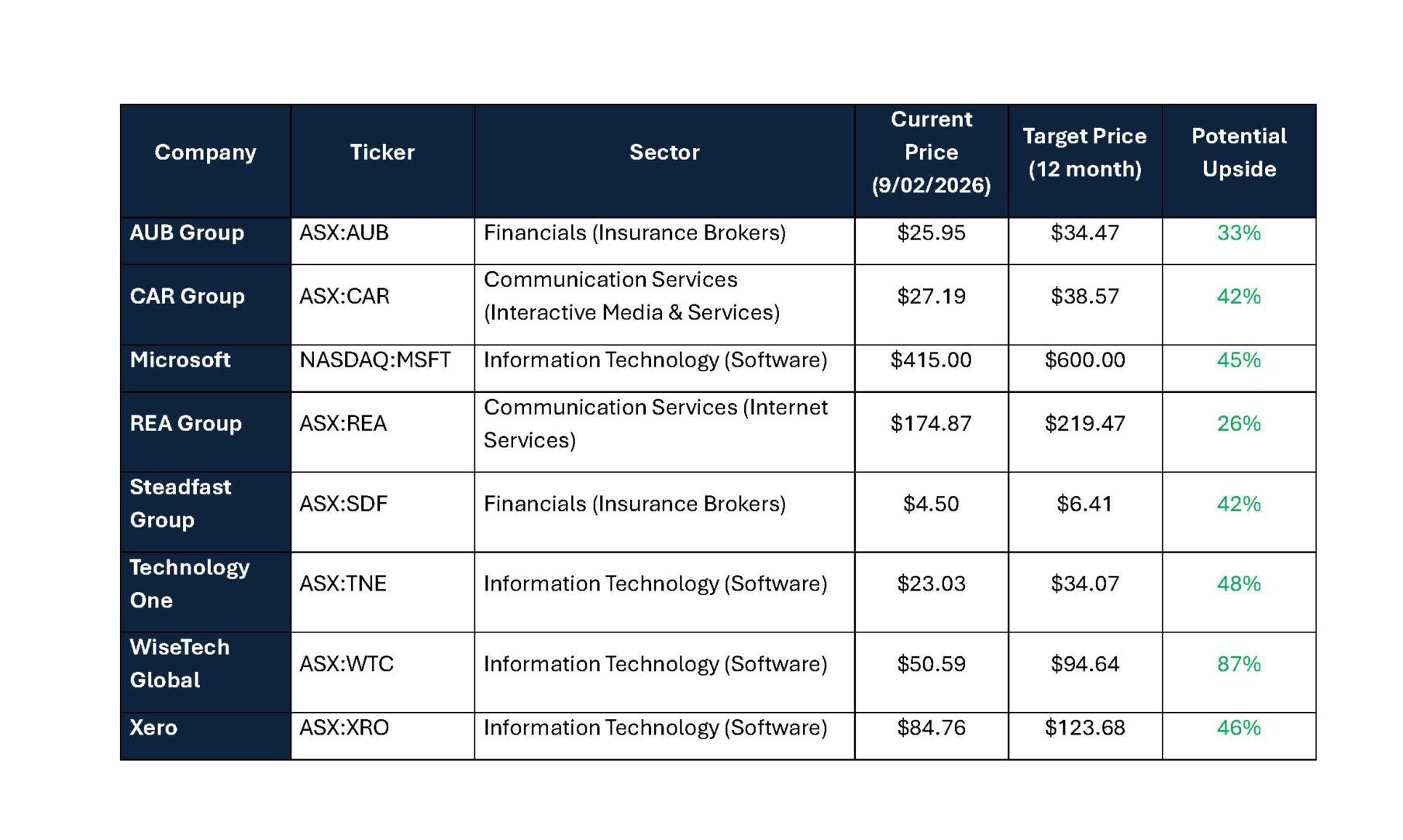
At the time of writing this article, Qi Wealth’s advisers are encouraging clients with excess cash in their portfolios to buy into a select group of excellent companies which are now trading at materially lower valuations than those experienced over the past few years. A list of stock’s Qi’s watchlist which have fallen substantially, without a decline in earnings to match, are mentioned below:
Source: Qi Wealth and Lonsec Irate, 10/02/2026
Article by Michael Hart

Principal and Head of Advice
E: Michael.hart@qiwealth.com.au
P: (02) 8247 2700
[1] Reimagining the future of insurance, InsurifyAI, https://insurifyai.com/, accessed 9th February 2026.
[2] AI: Boom, bubble, or both?, Commonwealth Bank of Australia, https://www.commbank.com.au/articles/newsroom/2026/02/ai-boom-bubble-or-both.html 9th February 2026.